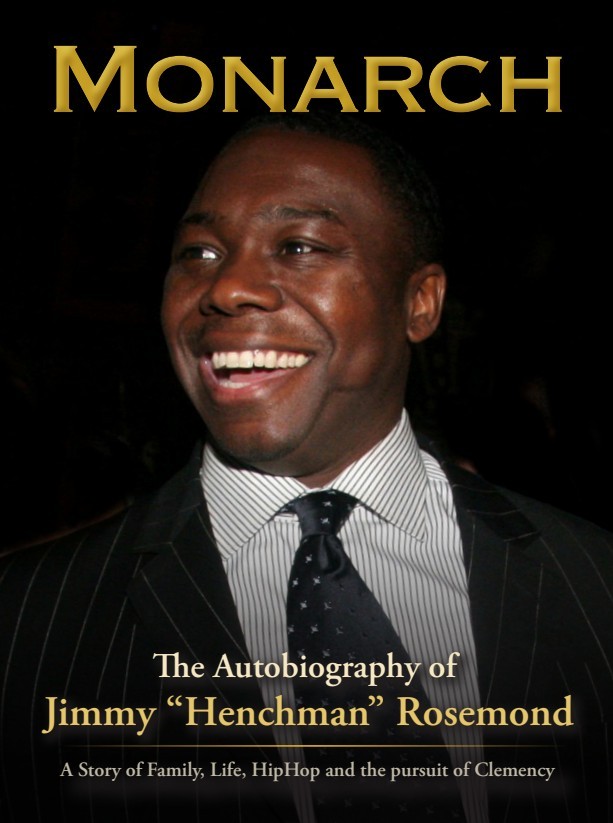
The Autobiography of
Jimmy "Henchman" Rosemond
A Story of Family, Life, HipHop
and the pursuit of Clemency

MONARCH
POWER WITH PURPOSE
The Autobiography of
Jimmy "Henchman" Rosemond
A Story of Family, Life, HipHop
and the pursuit of Clemency
MONARCH
POWER WITH PURPOSE
First published by Monarch publishing 2026 Copyright © 2026 by Jimmy “Henchman” Rosemond All rights reserved. No part of this publication may be reproduced, stored, or transmitted in any form or by any means, electronic, mechanical, photocopying, recording, scanning, or otherwise without written permission from the publisher. It is illegal to copy this book, post it to a website, or distribute it by any other means without permission. Jimmy “Henchman” Rosemond asserts the moral right to be identified as the author of this work.
First published by Monarch publishing 2026 Copyright © 2026 by Jimmy “Henchman” Rosemond All rights reserved. No part of this publication may be reproduced, stored, or transmitted in any form or by any means, electronic, mechanical, photocopying, recording, scanning, or otherwise without written permission from the publisher. It is illegal to copy this book, post it to a website, or distribute it by any other means without permission. Jimmy “Henchman” Rosemond asserts the moral right to be identified as the author of this work.
Where death is, we are not.
–Gladiator
For Jabulani, Nadege, and Iman
CONTENTS
PROLOGUE
1 FAM POU FAM
2 BROOKLYN
3 FLATBUSH
4 GROWING PAINS
5 VANDERVEER
6 COMING OF AGE
7 THE UNTOUCHABLES
8 JIMMY ACE
9 EXILED
10 IT COSTS TO BE THE BOSS
11 RIKERS ISLAND
12 SETTLING THE SCORE
13 IT’S BEEN A LONG TIME COMING
14 WELCOME HOME
15 CRACK IS WACK
16 BEATING THE ODDS
17 YOU MIGHT HAVE HEARD OF ME
18 GHOSTS DON’T DIE EASY
19 CATCH ME IF YOU CAN
20 LET’S DANCE TO THE MUSIC
21 HENCHMEN ENTERTAINMENT
22 FATE
23 HOUDINI
24 THE CROSS OVER
25 TUPAC SHAKUR
26 SUGE KNIGHT
27 PUFF “P DIDDY” COMBS
28 END OF THE ROPE
29 TOE TO TOE
30 BARRY HANKERSON
31 AALIYAH
32 AS A MAN THINKETH
33 CZAR ENTERTAINMENT
34 MIKE TYSON
35 THE GAME
36 THE LOS ANGELES TIMES & THE DAILY NEWS
37 GUCCI MANE
38 GODS OF WAR
39 YACŪB THE BIG HEAD SCIENTIST
40 DEAR MAMA
41 BETRAYAL
42 CAPTURED
43 JEFFREY LICHTMAN
44 TRIALS
45 PURGATORY
46 AGAINST ALL ODDS
AFTERWORD
CONTENTS
PROLOGUE
1 FAM POU FAM
2 BROOKLYN
3 FLATBUSH
4 GROWING PAINS
5 VANDERVEER
6 COMING OF AGE
7 THE UNTOUCHABLES
8 JIMMY ACE
9 EXILED
10 IT COSTS TO BE THE BOSS
11 RIKERS ISLAND
12 SETTLING THE SCORE
13 IT’S BEEN A LONG TIME COMING
14 WELCOME HOME
15 CRACK IS WACK
16 BEATING THE ODDS
17 YOU MIGHT HAVE HEARD OF ME
18 GHOSTS DON’T DIE EASY
19 CATCH ME IF YOU CAN
20 LET’S DANCE TO THE MUSIC
21 HENCHMEN ENTERTAINMENT
22 FATE
23 HOUDINI
24 THE CROSS OVER
25 TUPAC SHAKUR
26 SUGE KNIGHT
27 PUFF “P DIDDY” COMBS
28 END OF THE ROPE
29 TOE TO TOE
30 BARRY HANKERSON
31 AALIYAH
32 AS A MAN THINKETH
33 CZAR ENTERTAINMENT
34 MIKE TYSON
35 THE GAME
36 THE LOS ANGELES TIMES & THE DAILY NEWS
37 GUCCI MANE
38 GODS OF WAR
39 YACŪB THE BIG HEAD SCIENTIST
40 DEAR MAMA
41 BETRAYAL
42 CAPTURED
43 JEFFREY LICHTMAN
44 TRIALS
45 PURGATORY
46 AGAINST ALL ODDS
AFTERWORD
Listen to the prologue
Audio narration
0:00/1:34
Listen to the prologue
Audio narration
0:00/1:34
PROLOGUE
Long before the How Can I Be Down music conference, Henchmen Entertainment’s top-charting records, the Vibe Awards, courts, headlines, or sentences, there was a boy learning how the world worked by watching what it punished and what it rewarded. Power revealed itself early—I learned that survival wasn’t just instinct; it was strategy. And strategy, when practiced long enough, becomes identity.
I grew up in spaces where identity arrived before opportunity, where being Haitian and Black carried meanings assigned by others. Some lessons came from family, some from the streets, and some from institutions that claimed neutrality while enforcing hierarchy. I learned quickly that ambition without permission comes with consequences, and that refusing to accept limits often invites resistance. Still, I moved forward—not blindly, but deliberately— knowing the cost and accepting it.
This story is not a defense of every choice I made, nor is it a confession meant to absolve me. It is an accounting—a record of how a life unfolds when shaped by pressure, contradiction, loyalty, hunger, and belief. I have been many things at once— builder and breaker, student and teacher, insider and outsider. Reducing that complexity to a single narrative has always been convenient for others, but it has never been true to my story. What follows is not mythology or justification. It is context. Before judgment, there must be understanding. Before conclusions, there must be history. This book begins with roots, and to know the man, you must first know the dust and dirt that made him.
By the time the sentence was handed down, my name already carried weight. On the streets. In the music industry. In rooms where deals were made and fortunes were gifted.
This book was born in that vein—to clear the air on all issues. I don’t want a writer who doesn’t know me saying what happened or what I was thinking during certain historical hip-hop events. This is not an appeal for sympathy, nor a plea for forgiveness. It is a record. A witness. A reckoning. Before you judge the man I became, you must understand the boy I was, the world that shaped me, and the choices made when survival was never optional. This story begins long before prison—but prison is where its meaning became unavoidable, because I knew the truth of my life could not be reduced to the version written by prosecutors and headlines.
PROLOGUE
Long before the How Can I Be Down music conference, Henchmen Entertainment’s top-charting records, the Vibe Awards, courts, headlines, or sentences, there was a boy learning how the world worked by watching what it punished and what it rewarded. Power revealed itself early—I learned that survival wasn’t just instinct; it was strategy. And strategy, when practiced long enough, becomes identity.
I grew up in spaces where identity arrived before opportunity, where being Haitian and Black carried meanings assigned by others. Some lessons came from family, some from the streets, and some from institutions that claimed neutrality while enforcing hierarchy. I learned quickly that ambition without permission comes with consequences, and that refusing to accept limits often invites resistance. Still, I moved forward—not blindly, but deliberately— knowing the cost and accepting it.
This story is not a defense of every choice I made, nor is it a confession meant to absolve me. It is an accounting—a record of how a life unfolds when shaped by pressure, contradiction, loyalty, hunger, and belief. I have been many things at once— builder and breaker, student and teacher, insider and outsider. Reducing that complexity to a single narrative has always been convenient for others, but it has never been true to my story. What follows is not mythology or justification. It is context. Before judgment, there must be understanding. Before conclusions, there must be history. This book begins with roots, and to know the man, you must first know the dust and dirt that made him.
By the time the sentence was handed down, my name already carried weight. On the streets. In the music industry. In rooms where deals were made and fortunes were gifted.
This book was born in that vein—to clear the air on all issues. I don’t want a writer who doesn’t know me saying what happened or what I was thinking during certain historical hip-hop events. This is not an appeal for sympathy, nor a plea for forgiveness. It is a record. A witness. A reckoning. Before you judge the man I became, you must understand the boy I was, the world that shaped me, and the choices made when survival was never optional. This story begins long before prison—but prison is where its meaning became unavoidable, because I knew the truth of my life could not be reduced to the version written by prosecutors and headlines.
MAGNUM OPUS
“The supreme art of war is to subdue the enemy
without fighting.”
–Sun Tzu
Listen to this chapter
Listen to this chapter
Chapter 1
Fam-pou-fam
Audio narration
0:00/1:34
CHAPTER 1
FAM POU FAM (FAMILY FOR FAMILY)
“Let them remain obscure—
I’ve made history already…”
— Jimmy Rosemond
Before I was born, a pact was made. Not just between my mother and father, but between entire bloodlines. A covenant sealed by sacrifice and faith—fam pou fam. Family for family.
My mother, Andrea Fraiser, was young but disciplined. She was the oldest of eight children—four boys and four girls. Her sisters were Josette, Joseline, and Jeanette, and the boys were Serge, Alfred, Edouard, and Wilfred. She met Constantine Rosemond, who was a country boy but stern and handy with his hands, in the hills of Pétion-Ville, a neighborhood high above the dust and noise of Port-au-Prince, Haiti. They were married young, like many back then, driven by duty and hope. Four children followed: Mario, Lyonel, Nadege, and Kesner. Life was hard—not just financially. Haiti in the 1950s and ’60s was a nation gripped by fear and silence.
François “Papa Doc” Duvalier ruled the country with iron hands and ghost voices. His private death squad, the Tonton Macoute, were whispered about in the dark and never seen in daylight. They moved like shadows, snatching dissidents in the middle of the night. Those who weren’t part of the inner circle of the Haitian elite told stories of what happened secretly. My family called them MONARCH 2 Lougawou—monsters cloaked in fear and voodoo mystique. In Haiti, skin color could determine your future, and my parents—Black, working-class— lived under a hierarchy they didn’t create but had to survive.
But Haiti wasn’t just fear. It was also resilience. Over 150 years of freedom made Haitians understand the love and hate independence brought. It was family. And that’s what pulled them forward.
The family made a collective decision: someone would leave. Then another. Then another. Money was pooled. Names were discussed. It was migration as a sacred mission. One would go to America, work, send money, and then bring the next. Fam pou fam.
In 1963, my parents landed on the East Side of 96th Street and Lexington Avenue, on the fringes of Harlem. They found a modest apartment and made it a sanctuary. They found work quickly—my mother became a skilled nurse’s aide, and my father a carpenter. Both were disciplined. Both were survivors. But what weighed on them most wasn’t rent or racism—it was the ache of missing their children back in Haiti. Four kids. Separated by thousands of miles, but never once forgotten. The children, too young to understand the sacrifice, were cared for by my grandparents and their aunts and uncles.
They would call Haiti monthly—something most couldn’t afford—to reassure Mario, Lyonel, Nadege, and Kesner: “Nou p’ap janm bliye nou.” We haven’t forgotten you.
Then, in 1965, while working and saving for the family’s reunification, a surprise came.
I was born. February 5, 1965, at Metropolitan Hospital in East Harlem. A winter baby. The American-born son of Haitian pioneers. For the first few months, I was the baby my siblings had never met—a name and face shared through static phone lines and grainy photos. But soon, they came. One by one. My brothers and sister met me for the first time—this loud, wide-eyed, curlyhaired baby who didn’t know the Creole they spoke but carried the same blood. That moment was a rebirth for the family. We were whole. We were Haitians MONARCH 3 in America, threaded together by sacrifice and love. There was no parade. No big banner. Just a quiet victory in a cold apartment on 96th and Lex. My mother worked night shifts, then came home to iron uniforms and pack lunches. My father’s hands were stained with sawdust and ambition. They came with nothing, but what they gave us was everything: pride, protection, and a belief in possibility. Even now, I look back at that foundation not with pity, but with deep reverence. I wasn’t just born into a family. I was born into a code. A legacy. I didn’t know it back then, but this was our Christopher Columbus adventure— without annihilating a soul to survive. Every time my siblings and I ventured beyond the threshold of that apartment, there was something new to talk about. All we had was ourselves until the rest of the family joined us. I would hear it often in my household: fam pou fam.
CHAPTER 1
FAM POU FAM (FAMILY FOR FAMILY)
“Let them remain obscure—
I’ve made history already…”
— Jimmy Rosemond
Before I was born, a pact was made. Not just between my mother and father, but between entire bloodlines. A covenant sealed by sacrifice and faith—fam pou fam. Family for family.
My mother, Andrea Fraiser, was young but disciplined. She was the oldest of eight children—four boys and four girls. Her sisters were Josette, Joseline, and Jeanette, and the boys were Serge, Alfred, Edouard, and Wilfred. She met Constantine Rosemond, who was a country boy but stern and handy with his hands, in the hills of Pétion-Ville, a neighborhood high above the dust and noise of Port-au-Prince, Haiti. They were married young, like many back then, driven by duty and hope. Four children followed: Mario, Lyonel, Nadege, and Kesner. Life was hard—not just financially. Haiti in the 1950s and ’60s was a nation gripped by fear and silence.
François “Papa Doc” Duvalier ruled the country with iron hands and ghost voices. His private death squad, the Tonton Macoute, were whispered about in the dark and never seen in daylight. They moved like shadows, snatching dissidents in the middle of the night. Those who weren’t part of the inner circle of the Haitian elite told stories of what happened secretly. My family called them Lougawou—monsters cloaked in fear and voodoo mystique. In Haiti, skin color could determine your future, and my parents—Black, working-class— lived under a hierarchy they didn’t create but had to survive.
But Haiti wasn’t just fear. It was also resilience. Over 150 years of freedom made Haitians understand the love and hate independence brought. It was family. And that’s what pulled them forward.
The family made a collective decision: someone would leave. Then another. Then another. Money was pooled. Names were discussed. It was migration as a sacred mission. One would go to America, work, send money, and then bring the next. Fam pou fam.
In 1963, my parents landed on the East Side of 96th Street and Lexington Avenue, on the fringes of Harlem. They found a modest apartment and made it a sanctuary. They found work quickly—my mother became a skilled nurse’s aide, and my father a carpenter. Both were disciplined. Both were survivors. But what weighed on them most wasn’t rent or racism—it was the ache of missing their children back in Haiti. Four kids. Separated by thousands of miles, but never once forgotten. The children, too young to understand the sacrifice, were cared for by my grandparents and their aunts and uncles.
They would call Haiti monthly—something most couldn’t afford—to reassure Mario, Lyonel, Nadege, and Kesner: “Nou p’ap janm bliye nou.” We haven’t forgotten you.
Then, in 1965, while working and saving for the family’s reunification, a surprise came.
I was born. February 5, 1965, at Metropolitan Hospital in East Harlem. A winter baby. The American-born son of Haitian pioneers. For the first few months, I was the baby my siblings had never met—a name and face shared through static phone lines and grainy photos. But soon, they came. One by one. My brothers and sister met me for the first time—this loud, wide-eyed, curlyhaired baby who didn’t know the Creole they spoke but carried the same blood. That moment was a rebirth for the family. We were whole. We were Haitians in America, threaded together by sacrifice and love. There was no parade. No big banner. Just a quiet victory in a cold apartment on 96th and Lex. My mother worked night shifts, then came home to iron uniforms and pack lunches. My father’s hands were stained with sawdust and ambition. They came with nothing, but what they gave us was everything: pride, protection, and a belief in possibility. Even now, I look back at that foundation not with pity, but with deep reverence. I wasn’t just born into a family. I was born into a code. A legacy. I didn’t know it back then, but this was our Christopher Columbus adventure— without annihilating a soul to survive. Every time my siblings and I ventured beyond the threshold of that apartment, there was something new to talk about. All we had was ourselves until the rest of the family joined us. I would hear it often in my household: fam pou fam.